
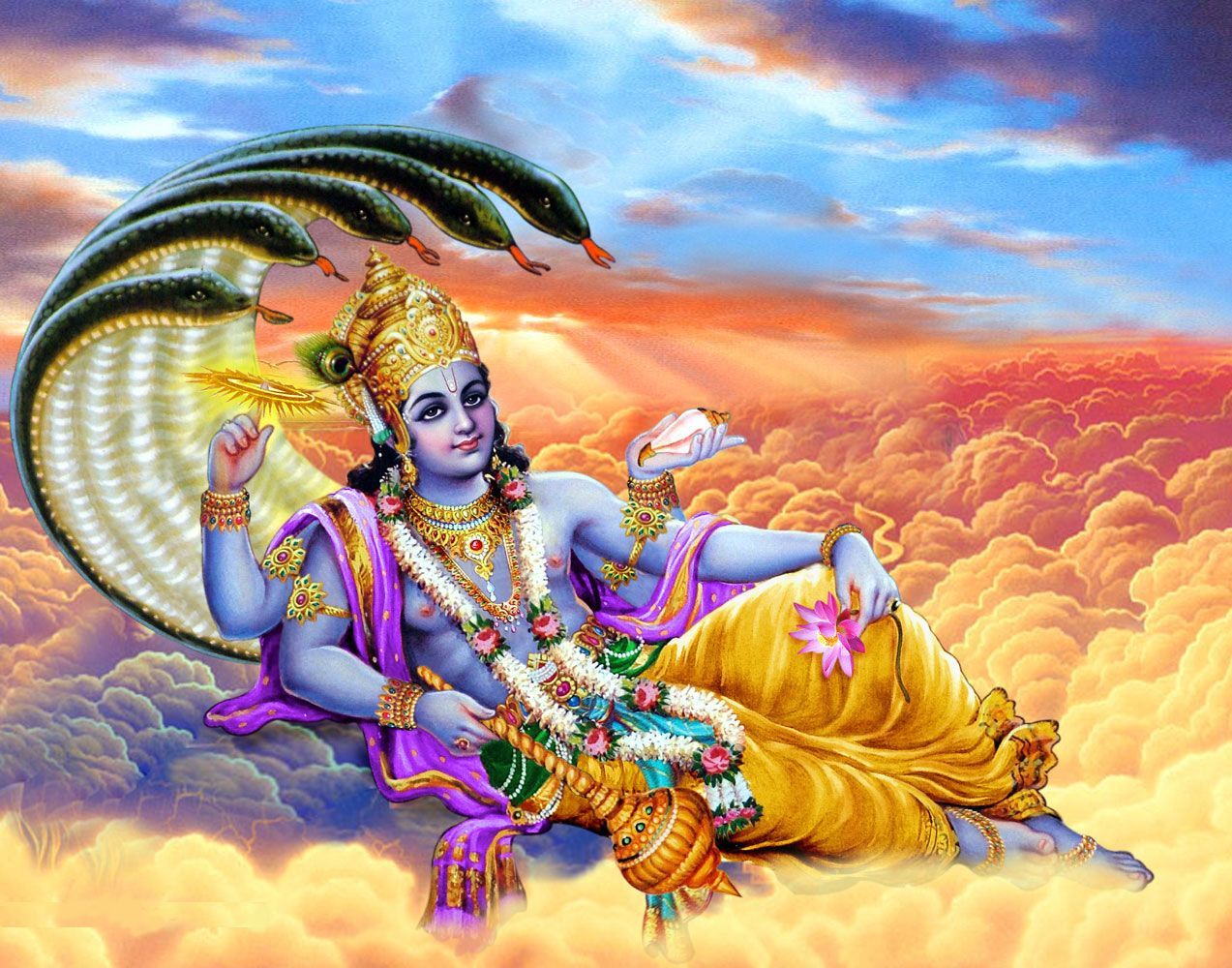
This translation is based on the Shri Shankara bhAshya from AdhyAtma prakAshana. This was originally transcribed in Kannada and then translated from Kannada to English using ChatGPT.
The Vishnu Sahasranama needs no introduction. This great hymn, found in the Anushasana Parva of the Mahabharata, was gifted to us by Vedavyasa. It is called both a “stotra” (hymn) and a “mantra,” because it is not merely poetic praise, but a divine chant of sacred names endowed with mantric power.
This hymn contains around 107 verses, within which appear the “Sahasra” — the thousand names. Yet “thousand” here should not be understood merely as a number. The word symbolizes infinity: infinite qualities, infinite forms, and infinite glory. It is a magnificent divine composition encompassing the countless forms, virtues, deeds, compassion, and power of Lord Vishnu.
The greatness of this hymn is testified by the words of Bhishma himself. When Yudhishthira asks:
“Ko dharmaḥ sarva-dharmāṇāṁ bhavataḥ paramo mataḥ?” “What, in your opinion, is the highest dharma among all dharmas?”
Bhishma replies:
“Jagat-prabhuṁ deva-devam anantaṁ puruṣottamam | Stuvan nāma-sahasreṇa puruṣaḥ satatotthitaḥ ||”
“To constantly praise the Lord of the universe, the God of gods, the Infinite One, the Supreme Person, through the thousand names — that is the highest dharma.”
He further says:
“Tam eva cārchayannityaṁ bhaktyā puruṣam avyayam |
Dhyāyan stuvan namasyanśca yajamānas tam eva ca ||”
“To worship Him alone daily with devotion, to meditate upon Him, praise Him, bow before Him — this is the supreme path.”
Thus Bhishma’s conclusion is clear:
“Eṣa me sarva-dharmāṇāṁ dharmo’dhikatamo mataḥ”
“This, in my view, is the highest among all dharmas.”
In other words, remembering, chanting, and worshipping the divine names of Krishna / Mahavishnu is the highest dharma.
Invocation Verses of the Vishnu Sahasranama
“Shuklāmbaradharam Viṣṇum…”
शुक्लाम्बरधरं विष्णुं शशिवर्णं चतुर्भुजम् ।
प्रसन्नवदनं ध्यायेत् सर्वविघ्नोपशान्तये ॥
“One should meditate upon Vishnu, clad in white garments, moon-like in complexion, four-armed, and ever serene-faced, so that all obstacles may be pacified.”
Though “Shukla” literally means “white,” it symbolizes purity and sattva. The Lord’s garment is truly the sky itself. How can the all-pervading Lord be confined to any single garment? “Shashi-varṇa” (moon-like) points to His cooling and soothing nature — just as the moon relieves heat, the Lord removes the burning afflictions of those who remember Him.
Being all-pervading in every direction, He is “Chaturbhuja” — four-armed. Ever fulfilled and complete, He is “Prasanna-vadana,” eternally serene, for He lacks nothing. Through meditation upon Him, perhaps even a small fraction of these qualities may awaken in us.
“Vyāsam Vaśiṣṭha-naptāram…”
व्यासं वसिष्ठनप्तारं शक्तेः पौत्रमकल्मषम् ।
पराशरात्मजं वन्दे शुकतातं तपोनिधिम् ॥
“I bow to Sage Vyasa — grandson of Vasishta, descendant of Shakti, son of Parashara, father of Shuka, sinless and a treasure of tapas.”
“Vyāsāya Viṣṇu-rūpāya…”
व्यासाय विष्णुरूपाय व्यासरूपाय विष्णवे ।
नमो वै ब्रह्मनिधये वासिष्ठाय नमो नमः ॥
“Vyasa is the very form of Vishnu, and Vishnu Himself appears as Vyasa. Salutations again and again to Vyasa, the treasure-house of Vedic wisdom.”
“Avikārāya Śuddhāya…”
अविकाराय शुद्धाय नित्याय परमात्मने ।
सदैकरूपरूपाय विष्णवे सर्वजिष्णवे ॥
“Salutations to Vishnu — changeless, pure, eternal, the Supreme Self, ever of one divine nature, and victorious over all.”
“Yasya Smaraṇa-mātreṇa…”
यस्य स्मरणमात्रेण जन्मसंसारबन्धनात् ।
विमुच्यते नमस्तस्मै विष्णवे प्रभविष्णवे ॥
“By whose mere remembrance a being is freed from the bondage of birth and worldly existence — unto that Lord Vishnu, the source of all, I bow.”
“Om Namo Viṣṇave…”
ॐ नमो विष्णवे प्रभविष्णवे ॥
“Om — salutations to Vishnu, the all-pervading One, the source of creation, who pervades everything.”
These opening verses are not merely invocatory hymns. They establish the very spirit of the Vishnu Sahasranama: meditation, the nature of the Supreme Self, and the glory of divine name-remembrance.
Yudhishthira’s Questions
Śrī Vaiśampāyana said:
“Having heard in full the many sacred teachings on dharma, Yudhishthira again addressed Bhishma, the son of Shantanu.”
Here, Vaiśampāyana narrates the dialogue to King Janamejaya. Yudhishthira had already heard from Bhishma teachings on kingly duties, ethics, charity, conduct, political science, warfare, and many forms of dharma. Yet one final question remained in his heart:
“What is the essence of all these?
What is the supreme path that leads man to the highest good?”
The phrase used by Vyasa is deeply significant:
“Śāntanavaḥ punarevābhyabhāṣata”
“Bhishma, son of Shantanu, again spoke.”
The word “punar eva” (“again”) is profound. It does not imply that Bhishma was inventing something new. Rather, he was restating an eternal truth already known in the Sanatana tradition.
Thus, the Vishnu Sahasranama is not Bhishma’s personal composition. It is an ancient and timeless revelation handed down through sacred tradition. In the final moments of his life, lying upon the bed of arrows, Bhishma restated this eternal teaching to Yudhishthira.
The essence is this:
All dharmas ultimately culminate in remembrance of the Divine Name, surrender to God, and contemplation of the Supreme Reality.
Therefore, the Vishnu Sahasranama is not merely a hymn — it is the culmination of all dharmic wisdom. It is the confluence where knowledge (jnana), devotion (bhakti), detachment (vairagya), and surrender (sharanagati) meet.
The Six Great Questions of Yudhishthira
These questions are not ordinary questions. They are humanity’s eternal spiritual inquiry.
1. “Kim ekaṁ daivataṁ loke?”
“What is the one Supreme Divinity in this world?”
Among countless deities and powers, what is the ultimate source underlying all?
The word “ekaṁ” (one) is crucial. Yudhishthira is not merely asking which deity is greater than others, but what the ultimate Reality behind all divine manifestations is.
The word “daivata” itself comes from the root “div” — to shine, illumine, govern. By whose command does the sun rise, the wind blow, time move, and beings function? Who is that supreme regulator?
2. “Kiṁ vāpy ekaṁ parāyaṇam?”
“What is the supreme refuge for humanity?”
“Parāyaṇa” means the final destination, the ultimate shore where all striving ends. Beyond dharma, wealth, desire, and even liberation, what alone remains as the eternal refuge?
Adi Shankaracharya explains this question as one concerning the means to liberation itself.
He says:
“Yasya vijñāna-mātreṇa ānanda-lakṣaṇo mokṣaḥ prāpyate”
“By realizing That alone, liberation — whose nature is bliss — is attained.”
Here “vijñāna” does not mean intellectual information, but direct realization of Brahman.
He further says:
“Yad vidvān na bibheti kutaścana”
“One who realizes That fears nothing.”
Fear arises only from duality — the sense of “I” and “other.” When everything is realized as the one Brahman, fear disappears.
This echoes the famous statement of the Brihadaranyaka Upanishad:
“Dvitīyād vai bhayaṁ bhavati”
“Fear indeed arises from duality.”
Shankara then deepens the meaning further:
“Yat praviṣṭasya na vidyate punarbhavaḥ”
“One who attains That never returns again to birth.”
This is the very definition of moksha.
He cites the declaration of the Mundaka Upanishad:
“Brahmavid brahmaiva bhavati”
“The knower of Brahman becomes Brahman.”
And finally:
“Nānyaḥ panthā vidyate’yanāya”
“There is no other path.”
Thus “Parāyaṇa” means:
- The ultimate refuge
- The final goal
- That which destroys fear
- The knowledge that ends rebirth
- The supreme truth by knowing which one becomes That itself
Bhishma presents Vishnu as that supreme refuge — approached through name, form, worship, and meditation, ultimately leading the seeker into the formless Absolute.
The Complete Set of Questions
Yudhishthira’s questions form the foundation of the Vishnu Sahasranama:
- Kim ekaṁ daivataṁ loke? What is the Supreme Divinity?
- Kiṁ vā ekaṁ parāyaṇam? What is the ultimate refuge?
- Stuvantaḥ kam? Whom should one praise?
- Kam arcantaḥ?Lord Vishnu is the preserver and upholder of dharma in Hinduism. In Vaishnavism, He is regarded as the Supreme Self. The word “Vishnu” itself carries the meaning of the giver, sustainer, and provider of all things.
- Prāpnuyur mānavāḥ śubham? How do human beings attain true auspiciousness? “Śubham” here means not merely worldly welfare, but purity of mind, peace, fearlessness, righteousness, and liberation
- Ko dharmaḥ sarva-dharmāṇāṁ bhavataḥ paramo mataḥ? Which is the highest dharma among all dharmas?
- Kiṁ japan mucyate jantuḥ janma-saṁsāra-bandhanāt? By chanting what can a being be freed from the bondage of birth and death?
This is the culmination of all inquiry: how to transcend samsara itself. Bhishma gives one integrated answer to all these questions: the remembrance and chanting of the thousand names of Vishnu.
Thus, the Vishnu Sahasranama is not merely a list of names. It is a condensed Vedantic response to the highest questions human beings can ask. For this reason, Adi Shankaracharya regarded it not merely as a devotional hymn, but as the very essence of the Upanishadic wisdom.
Comments
Post a Comment